Amitabha Buddha Thangka: Meaning, Symbols and the Pure Land of Sukhavati
Few images in Himalayan Buddhist art feel as quietly welcoming as a thangka of Amitabha. He sits in deep meditation, glowing red like a setting sun, a bowl resting in his lap and a calm, inward gaze on his face. Nothing about him is wrathful or dramatic. Yet behind that stillness lies one of the most widely loved teachings in Mahayana Buddhism: the promise of a pure land where practitioners can be reborn and continue toward awakening under ideal conditions.
This guide explains what an Amitabha thangka shows and why. It covers his colour, gestures and attributes, the paintings of his pure land, Sukhavati, his close ties to Chenrezig and Padmasambhava, and how people use the image in daily practice and at the end of life. It also offers practical pointers if you are thinking of bringing one into your home. Traditions differ on some details, and where they do, this article says so.
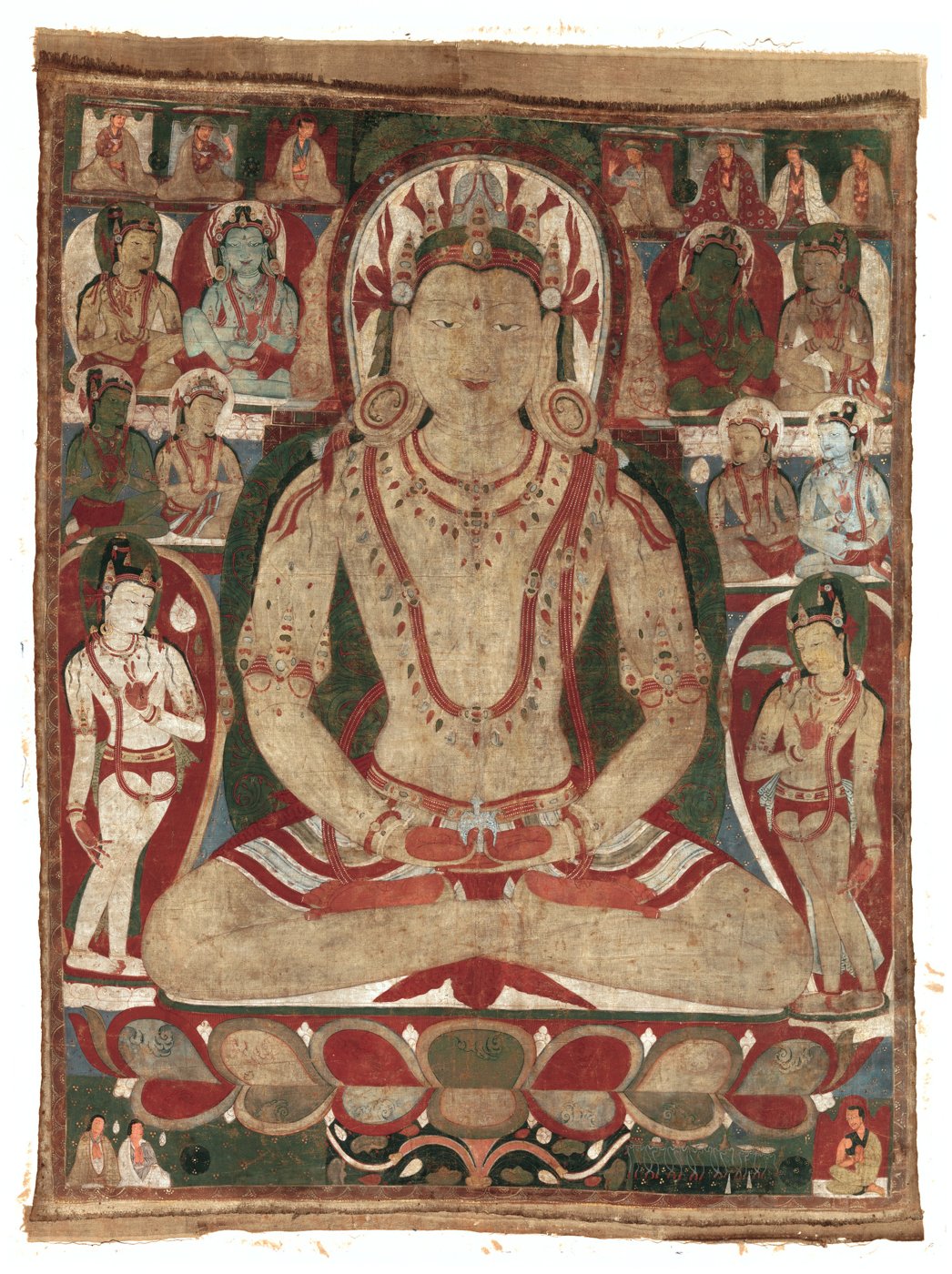
Who Is Amitabha, the Buddha of Infinite Light?
The name Amitabha is Sanskrit for "Infinite Light." In Tibetan he is called Öpame (often written Öpagmé), meaning "Boundless Light." He is one of the five buddha families described in Vajrayana Buddhism, presiding over the Lotus (Padma) family and associated with the western direction.
His story comes mainly from the Sukhavativyuha sutras, which survive in a longer and a shorter version. According to these texts, a monk named Dharmakara, many ages ago, made a series of great vows. The longer sutra is commonly described as listing forty-eight of them, though the number varies between recensions and translations. The heart of these vows was to create a perfected realm where any being who sincerely called on him could be reborn. Through countless lifetimes of practice, Dharmakara became the Buddha Amitabha, and his realm became Sukhavati, the "Land of Bliss," known in Tibetan as Dewachen.
Amitabha is revered across Buddhist Asia. In China and Japan, devotion to him grew into the Pure Land schools, where reciting his name is central. In Tibetan Buddhism he is honoured within a broader tantric framework, alongside meditation, mantra and the practices connected with dying. The figure is shared; the emphasis shifts from place to place.
Reading the Iconography: Colour, Mudra, Bowl and Throne
Thangka painting follows careful iconographic guidelines, so each element in an Amitabha image carries meaning. Once you know what to look for, the painting becomes much easier to read.
The Red Colour
Amitabha's body is red, the colour of the western sky at sunset. Within the five buddha families, red is linked with the element of fire and with the wisdom of discernment, sometimes called discriminating or discerning wisdom. This is the clear awareness that sees each thing in its own distinct qualities without confusion.
Red is also tied to desire and attachment. In Vajrayana thought, Amitabha represents the transformation of that clinging into compassionate, discerning wisdom. The warmth of the colour is not a warning; it is a picture of passion refined into care.
The Meditation Mudra
Amitabha's hands rest in his lap in the dhyana mudra, the gesture of meditation. The right hand lies on top of the left, palms up, thumbs often lightly touching. It signals complete mental stability and absorption. Of the five buddhas, he is the one most closely identified with this gesture.
The Begging Bowl
Resting on his joined hands is a monk's alms bowl. It recalls his renunciation and simple life as a monastic. In many paintings the bowl is shown filled with nectar (amrita), sometimes with fruits or medicine, symbolising the nourishment of the Dharma and, in some readings, freedom from death and decay.
The Lotus Throne and Moon Disc
He usually sits in full vajra posture on a lotus, with a moon disc beneath him. The lotus, rooted in mud yet blooming clean above the water, stands for purity arising within ordinary life. It is also the emblem of his Padma family. Some thangkas add a throne supported by peacocks, the traditional mount of the Lotus family. The peacock is said to eat poisonous plants without harm, a vivid image of turning harmful emotions into wisdom.
Monastic Robes, Not Jewels
Amitabha usually appears in plain patched monastic robes, with the elongated earlobes, ushnisha (cranial protuberance) and other marks of a buddha. If you see a red figure with a crown, jewellery and a long-life vase instead of a bowl, you are probably looking at Amitayus, discussed below.
Sukhavati: Painting the Pure Land
Many Amitabha thangkas show not just the Buddha but his whole realm. These Sukhavati paintings, often richly detailed, are based on descriptions in the sutras. Typical features include:
- Jewelled trees and terraces whose branches chime as the wind moves through them.
- Lotus ponds of pure water, where beings are shown being born from opening lotus buds rather than from a womb.
- Birds whose songs are said to teach the Dharma, often painted perched among flowering trees.
- Palaces and pavilions filled with bodhisattvas, offerings and celestial musicians.
- Rainbow light radiating from Amitabha, sometimes reaching down toward practitioners in the lower part of the painting.
In these scenes, Amitabha sits at the centre, usually larger than every other figure. He is commonly flanked by two bodhisattvas. In Tibetan art these are typically Chenrezig (Avalokiteshvara) on one side and Vajrapani on the other. In East Asian art the second attendant is usually Mahasthamaprapta, the bodhisattva of great strength. Some sources treat Mahasthamaprapta and Vajrapani as closely related, while others keep them distinct, so labels on older paintings can vary.
It is worth understanding how the tradition views the pure land itself. Sukhavati is not described as a final heaven. It is a place where conditions for practice are perfect, so beings born there can progress steadily toward full enlightenment. Some teachers also emphasise that a pure land reflects a purified mind, an interpretation that sits alongside more literal devotional understandings.
Amitabha, Amitayus and the Long-Life Connection
Amitabha has a close counterpart called Amitayus, "Infinite Life." Some traditions regard them as two aspects of the same buddha: Amitabha in his simple nirmanakaya-style monastic form, and Amitayus in his ornamented sambhogakaya form. Amitayus is also red and also seated in meditation, but he wears a crown and silks and holds a vase of long-life nectar.
Amitayus is one of the three long-life deities often painted together in Tibetan Buddhism, alongside Ushnishavijaya and White Tara. If you are building a small collection around the theme of longevity and healing, a guide to the White Tara thangka and her symbolism makes a natural companion to this one, since her seven eyes and white form complement Amitayus's red, vase-holding figure.
Telling the two apart matters if you are commissioning or buying a painting. Ask yourself whether the figure holds a bowl or a vase, and whether he wears robes or royal ornaments. That will usually tell you who you are looking at.
How Amitabha Relates to Chenrezig and Padmasambhava
Amitabha sits at the head of a spiritual lineage that is central to Tibetan Buddhism, especially in the Nyingma tradition.
Chenrezig, His Heart-Son
Chenrezig, the bodhisattva of compassion, belongs to Amitabha's Lotus family and is often called his spiritual son. In the popular eleven-faced, thousand-armed form of Chenrezig, a small red Amitabha usually appears at the very top of the stack of heads. Many standing and seated forms of Chenrezig also show a tiny Amitabha in the crown. This detail tells the viewer that compassion springs from, and is guided by, Amitabha's boundless wisdom.
Padmasambhava, the Lotus-Born
Padmasambhava, also known as Guru Rinpoche, is traditionally understood as an emanation connected with Amitabha. A common way of expressing this uses the three bodies of a buddha: Amitabha as the dharmakaya (the truth body), Chenrezig as the sambhogakaya (the enjoyment body) and Padmasambhava as the nirmanakaya (the emanation body). Some lineage paintings stack the three figures vertically, Amitabha at the top, to make this relationship visible.
In the Gelug tradition, the Panchen Lamas are regarded as emanations of Amitabha, another example of how the Buddha of Infinite Light is woven into Tibetan religious life.
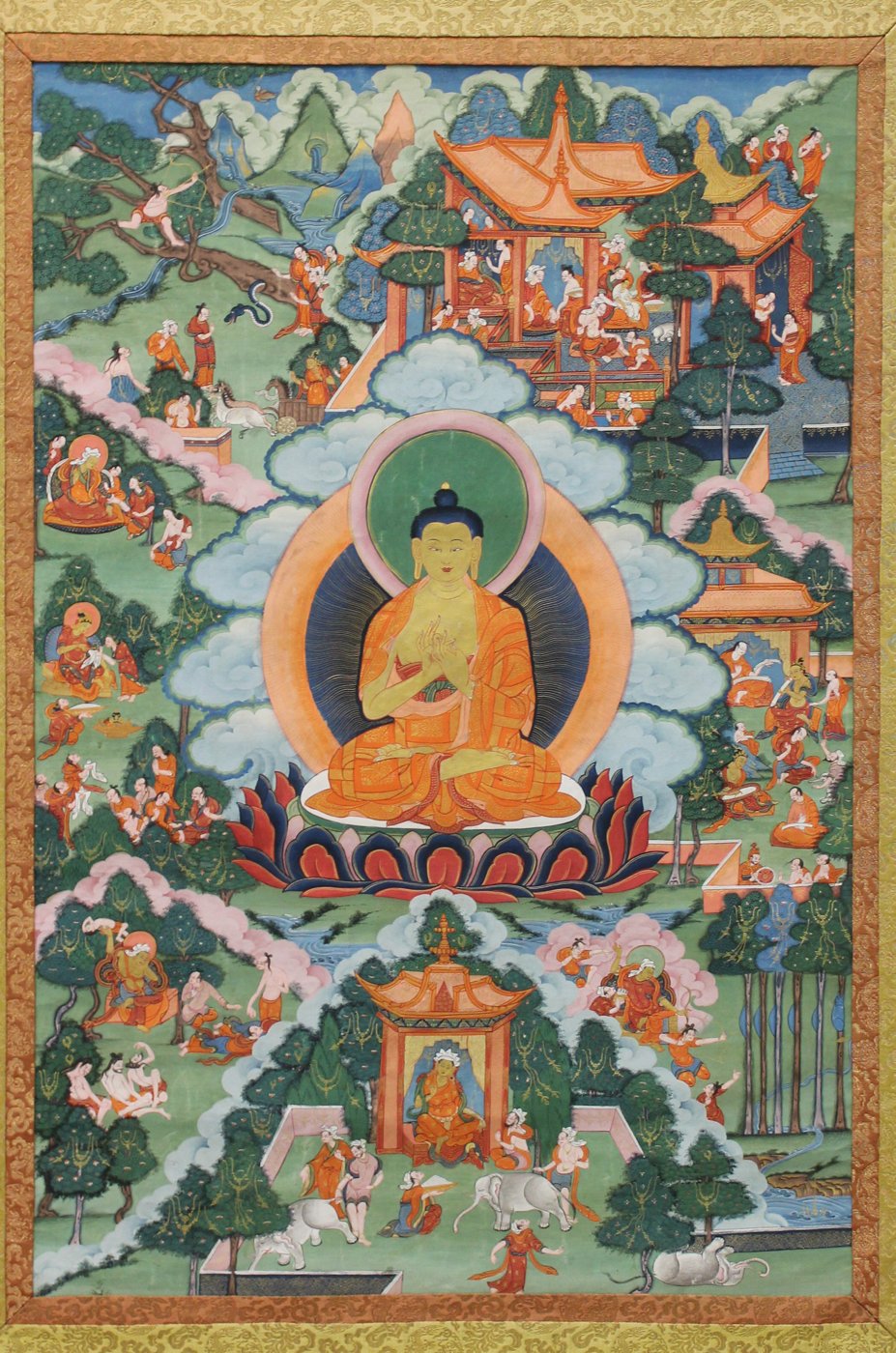
Using an Amitabha Thangka in Practice
An Amitabha thangka is meant to be used, not just admired. How it is used depends on the tradition and on guidance from a qualified teacher, but some common practices are widely known.
Daily Devotion and Recitation
- Name and mantra recitation. In East Asian Pure Land practice, practitioners recite "Namo Amituofo" or "Namu Amida Butsu." In Tibetan practice, a commonly recited mantra is "Om Ami Dewa Hrih."
- Aspiration prayers. In Tibetan communities, prayers for rebirth in Dewachen are widely recited. A well-known one was composed by the seventeenth-century master Karma Chagmé.
- Visualisation. The thangka serves as a reference for imagining Amitabha and his pure land in detail, a method described at length in the sutra on contemplating Amitayus.
The painting is traditionally hung at or above eye level, in a clean space, often facing the practitioner during meditation. Many people also make simple offerings in front of it, such as water bowls, a light or flowers.
At the Time of Death
Amitabha has a special place in practices connected with dying. In Tibetan Buddhism, the practice of phowa, or transference of consciousness, often involves visualising Amitabha above the crown of the head and directing the mind toward him at the moment of death. Phowa is normally taught only with proper instruction, and it should not be attempted from books alone.
More simply, families may place an Amitabha image where a dying person can see it, recite his name or mantra nearby and say aspiration prayers on their behalf. After death, these prayers are often continued, particularly during the forty-nine days that Tibetan tradition associates with the intermediate state, or bardo. Practices vary between lineages and families, so a local teacher or monastery is the best guide.
Practical Tips for Choosing an Amitabha Thangka
- Check the attributes. Look for a red body, the dhyana mudra and a bowl. A crown and vase indicate Amitayus instead.
- Look at the face and proportions. Traditional painters follow measured grids. A well-made image has a balanced, serene face and a symmetrical posture.
- Consider the composition. A single central Amitabha suits focused meditation. A full Sukhavati scene suits contemplation and teaching.
- Ask about materials and the painter. Honest sellers can describe pigments, whether the work is hand-painted, and where it was made.
- Think about consecration. Many practitioners have a thangka blessed by a lama before using it for practice. Some do this before hanging it; others arrange it later.
- Handle it with care. Avoid direct sunlight and damp walls, and keep it framed or properly mounted in brocade.
Frequently Asked Questions
Why is Amitabha always red?
Red links him with the western direction, the setting sun, the element of fire and discerning wisdom. It also reflects the transformation of desire and attachment into compassion, which is the particular quality associated with his Lotus family.
Is Sukhavati the same as heaven?
Not exactly. Sukhavati is understood as a pure land where beings can practise without obstacles until they reach full enlightenment. It is a stepping stone toward liberation rather than a final destination, though popular understanding varies.
What is the difference between Amitabha and Amitayus?
Both are red and seated in meditation. Amitabha typically wears monastic robes and holds a begging bowl. Amitayus wears a crown and ornaments and holds a long-life vase. Many traditions see them as two aspects of one buddha.
Can someone who is not Buddhist hang an Amitabha thangka?
Many people do, out of appreciation for the art and its message. Treat it respectfully: hang it in a clean place, avoid bathrooms or floors, and do not use it as casual decoration in disrespectful settings.
Where should an Amitabha thangka be placed at home?
A quiet room, at or above eye level, is traditional. Some people place it on a shrine or meditation corner. Others like it facing west, in keeping with Sukhavati's direction, though this is a custom rather than a strict rule.
Conclusion
An Amitabha thangka brings together some of the gentlest ideas in Buddhism: infinite light, discerning wisdom and the hope that every sincere being can find conditions for awakening. His red body, meditation mudra, nectar-filled bowl and lotus throne each point to that vision, while the radiant scenes of Sukhavati show what his vows are said to have created.
Whether you approach the image as a practitioner, a collector or simply a curious admirer, take time to learn its details. Knowing who sits at the centre, who stands beside him and how the painting is used will deepen your appreciation, and help you choose and care for a thangka that truly honours its tradition.