White Tara Thangka: The Seven-Eyed Goddess of Long Life
Among the many enlightened figures in Himalayan Buddhist art, few are as quietly luminous as White Tara. She sits poised on a moon disc, her body the color of autumn moonlight, gazing out with an expression that manages to be both tender and utterly steady. Look closer and you notice something unusual: eyes on her palms, eyes on the soles of her feet, and a third eye on her forehead. These seven eyes are her signature, and they say a great deal about who she is.
This guide explains how to read a White Tara thangka: what her eyes, posture, hand gestures, and flowers mean, how she fits into the trio of long-life deities alongside Amitayus and Ushnishavijaya, and why so many families commission or gift her image for health and longevity. It also offers practical guidance on judging the quality of a painting, so you can tell a carefully made sacred image from a hurried one.
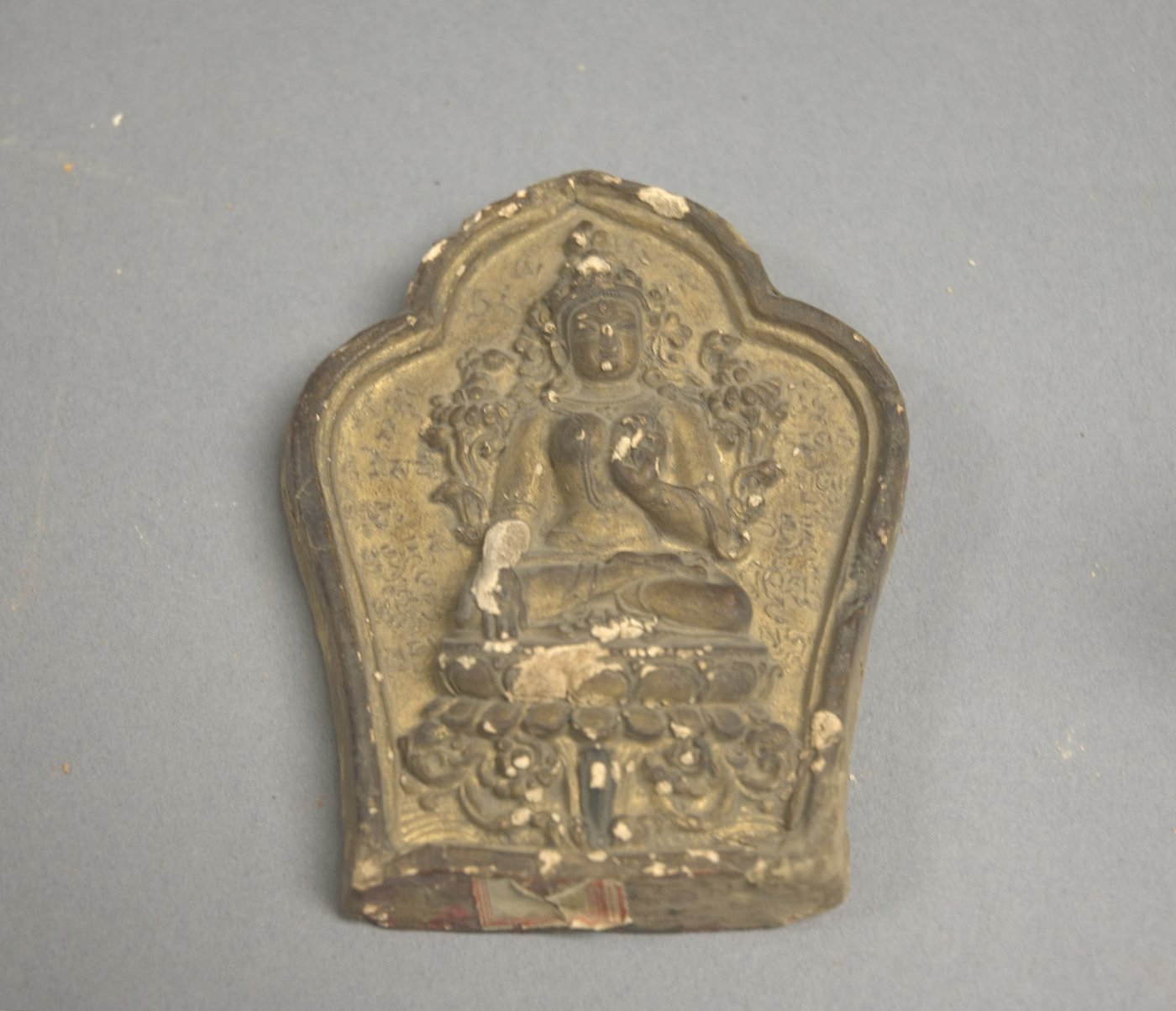
Who Is White Tara?
In Tibetan she is called Drolkar, the "White Liberator," and in Sanskrit Sita Tara. Tara as a whole is understood as a fully awakened being in female form, embodying the compassionate activity of all buddhas. Tibetan traditions describe many emanations of Tara, most famously the Twenty-One Taras, though the lists and iconography differ between lineages. Green Tara is associated with swift protection and fearless action. White Tara is associated with long life, healing, peace, and the clarity of wisdom.
Several origin accounts circulate. One widely told story says Tara arose from the tears of Avalokiteshvara, the bodhisattva of compassion, as he wept for the suffering of beings; some versions say Green Tara came from one tear and White Tara from the other, though which eye is which varies with the teller. Another account describes a princess named Yeshe Dawa, "Wisdom Moon," who vowed to reach enlightenment in a woman's body and to keep working for beings in that form. In Tibet, devotion to Tara is closely linked with the Indian master Atisha, who arrived in the eleventh century and is remembered for his reliance on her. A well-known White Tara practice is called the "Wish-Fulfilling Wheel," or Chintachakra.
The Seven Eyes: Seeing All Suffering
White Tara's seven eyes are the clearest way to tell her apart from other white female deities. She has the usual two eyes, a vertical third eye in the center of her forehead, an eye in the palm of each hand, and an eye on the sole of each foot.
Teachers explain the symbolism in slightly different ways, but the common thread is vigilant compassion. The eyes signify that nothing escapes her notice: she sees the suffering of beings in every direction and in every realm. The third eye is often linked with insight into ultimate reality, the eyes in her hands with compassionate action, and the eyes on her feet with her readiness to move toward anyone who calls on her. Some explanations connect the seven eyes to the doors of liberation or to awareness across the realms of existence.
For a painter, these extra eyes are a test of skill and patience. Each one should be drawn with the same care as the eyes on her face, with a gentle, almond shape and a calm gaze. Eyes on the palms and soles that look like afterthoughts, smudged or lopsided, are a warning sign. Buy authentic thangka painting from a studio willing to send close-up photographs of all seven eyes before you commit; it is one of the simplest ways to judge how much attention an artist has given the whole image. Buy authentic thangka painting from painters who treat every one of these eyes as carefully as the face, and the difference will be visible for years.
Posture, Mudras, and the Utpala Flower
The Vajra Posture
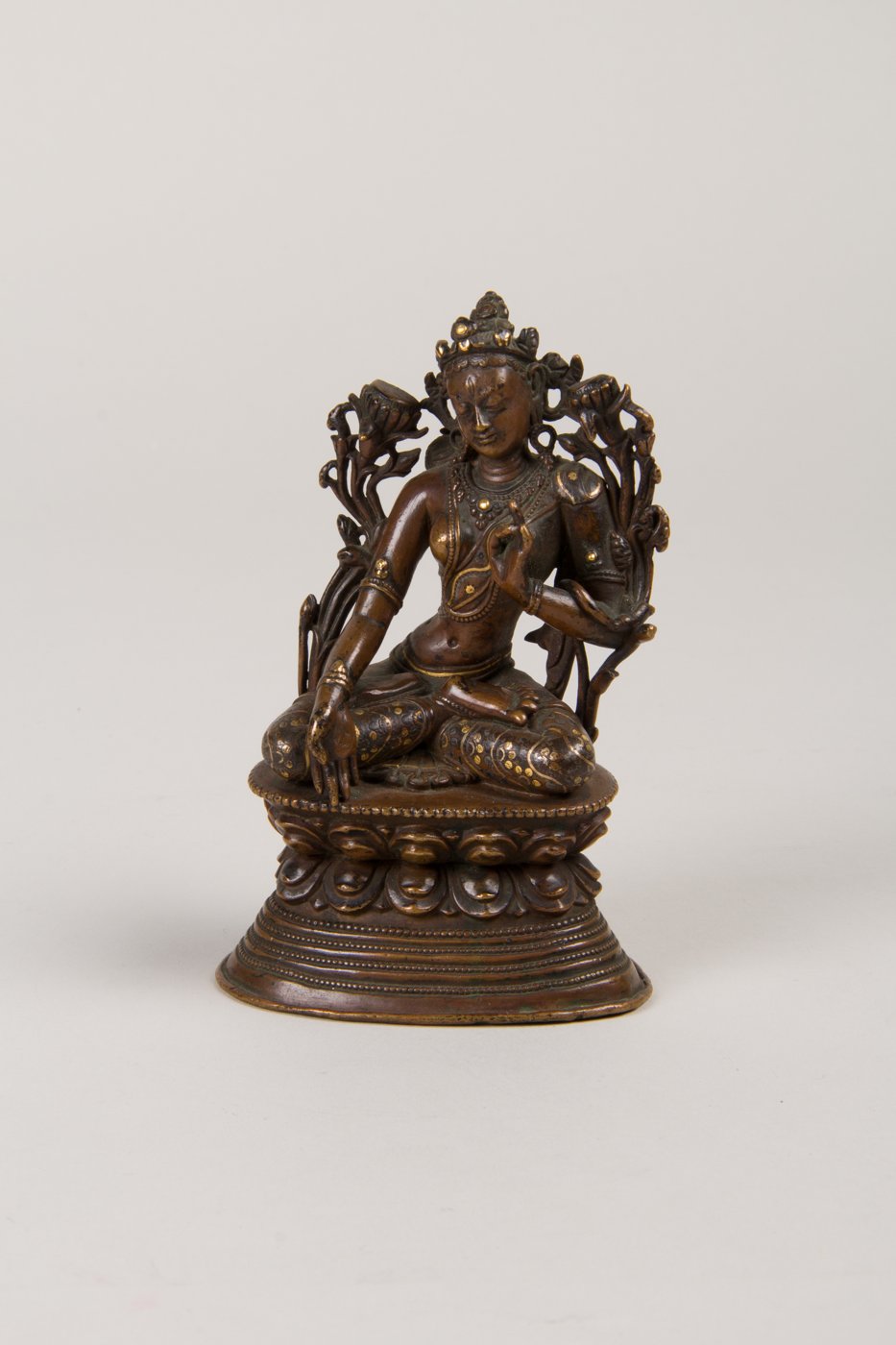
White Tara sits in the full vajra posture, legs crossed with both soles turned upward. This is the easiest way to distinguish her from Green Tara, who usually sits with her right leg extended, ready to step down into action. White Tara's crossed legs convey stability, meditative absorption, and the settled quality associated with long life. She typically sits on a moon disc atop a lotus, and a second moon disc often frames her back like a halo, reinforcing her cool, white, peaceful nature.
The Two Mudras
Her right hand rests on her right knee, palm facing outward, in the varada mudra, the gesture of generosity or granting wishes. Because the palm faces the viewer, the eye on it is clearly visible. Her left hand is raised at her heart, typically with the thumb and ring finger touching and the other three fingers raised. This is often described as the gesture of granting refuge, with the three upright fingers representing the Three Jewels: the Buddha, the Dharma, and the Sangha. The motif of an eye set in an open palm also appears in the thousand-armed form of Avalokiteshvara, which you can explore further in our guide to four- and thousand-armed Chenrezig, and the shared imagery is a reminder of how closely Tara and the bodhisattva of compassion are linked.
The Utpala Stem
Between the fingers of her left hand she holds the stem of an utpala, a lotus-like flower. In White Tara images the stem commonly branches into three blossoms: one a bud, one partly open, and one in full bloom. A frequent explanation is that these represent the buddhas of the past, present, and future, showing that Tara's compassion spans all time. Some commentaries offer other interpretations, and some paintings show a single flower or a different arrangement, so do not assume an image is incorrect just because it departs from the three-blossom pattern.
She is adorned like a royal bodhisattva, with a jeweled crown, earrings, necklaces, armlets, bracelets, and anklets, and flowing silk scarves and skirt. Her youthful appearance, often described as that of a sixteen-year-old, signifies freshness and vitality rather than literal age.
The Long-Life Trio: Amitayus, White Tara, and Ushnishavijaya
White Tara frequently appears as part of a group of three long-life deities, known in Tibetan as the Tsela Namsum. Each member brings a distinct emphasis:
- Amitayus, the Buddha of Boundless Life, is red, seated in meditation, and holds a long-life vase filled with nectar in his lap. He is usually the central figure.
- White Tara represents compassionate protection of life and the removal of obstacles to longevity.
- Ushnishavijaya, known in Tibetan as Namgyalma, is white with three faces and eight arms. She often holds a small image of Amitayus or a long-life vase and is associated with purifying negativity and extending life.
In a trio composition, Amitayus is typically placed in the center or at the top, with White Tara and Ushnishavijaya flanking him, though arrangements vary by region, lineage, and the wishes of the patron. Some thangkas show all three as equals; others make one deity the main subject with the remaining two in smaller form above or below. Long-life practices and empowerments often invoke the three together, which is why the set is such a popular subject for commissioned paintings.
Why People Commission or Gift a White Tara Thangka
In Himalayan Buddhist communities, commissioning a sacred image is regarded as a meritorious act in itself. A White Tara thangka is a natural choice when concern turns toward health and the length of a life well lived. Common occasions include:
- A significant birthday of a parent or grandparent, especially in later life.
- A period of illness, recovery, or medical treatment in the family.
- Prayers for the long life of a respected teacher, often offered with long-life ceremonies.
- Years considered astrologically challenging in Tibetan reckoning, when a teacher may recommend long-life practices.
- The birth of a child, as a wish for health and a long, meaningful life.
It helps to keep the tradition's own framing in mind. A White Tara thangka is not a charm that replaces medical care. It is a support for practice, prayer, and the cultivation of compassion, and its benefit is understood in terms of merit, intention, and connection with the Dharma. Many practitioners recite her mantra, commonly written as Om Tare Tuttare Ture Mama Ayuh Punya Jnana Pushtim Kuru Soha, while contemplating the image. Pronunciation and spelling differ somewhat between Tibetan and Sanskrit-based traditions.
If the painting is intended for practice, many owners ask a qualified lama to consecrate it, a ritual known as rabne. Consecration customs differ, so it is worth asking a teacher you trust rather than relying on a general rule.
What to Look for in a Well-Painted White Tara
The Face and Eyes
The face is the heart of the painting. It should be serene and gentle, with a soft half-smile and downcast eyes that feel calm rather than sleepy or vacant. Symmetry matters: the eyebrows, eyes, nose, and lips should balance precisely around the center line. In traditional practice, the eyes are often painted last in a short ceremony sometimes called the opening of the eyes, and that final step deserves the painter's steadiest hand. Check that the third eye sits upright and centered and that its proportions match the other eyes.
Proportions
Thangka painters work from an iconometric grid that fixes the relative measurements of each class of figure. A peaceful female deity like Tara has graceful, rounded proportions, a gently tapering torso, and a balanced triangular silhouette when seated. Look for a natural, harmonious relationship between head, shoulders, hands, and crossed legs. Oversized hands, a cramped torso, or a head that seems too large are signs that the grid was ignored or applied carelessly.
Fine Line Work and White Skin
Painting a white body well is surprisingly hard. Skilled artists build up subtle shading with fine strokes so that the figure has softness and volume without turning gray or chalky. The outline should be crisp and continuous, especially around the fingers and toes. Jewelry, silk folds, and the petals of the utpala should show deliberate, confident line work, often accented with gold. Buy authentic thangka painting from an artist or studio that can tell you plainly about the pigments, the canvas preparation, and how long the work took, and be wary of vague answers. A practical checklist:
- Ask for high-resolution close-ups of the face, hands, feet, and jewelry.
- Confirm the work is hand-painted, not a print with a few painted touches.
- Ask whether mineral or synthetic pigments were used, and whether gold is real gold.
- Check that all seven eyes are present and painted with equal care.
- Look at the background landscape and clouds; consistent quality throughout suggests a careful painter.
Price does not always track quality, but very cheap "hand-painted" White Taras with elaborate detail deserve extra scrutiny. Fine line work takes time, and time is what you are paying for. Buy authentic thangka painting from a source that shows clear close-up photographs of the face, eyes and hands before you commit.
Frequently Asked Questions
How can I tell White Tara from Green Tara?
White Tara is white, sits with both legs crossed in the vajra posture, and has seven eyes, including eyes on her palms and soles. Green Tara is green, usually extends her right leg, and normally has only two eyes, though she shares the same graceful ornaments and lotus flowers.
Is it appropriate for a non-Buddhist to own a White Tara thangka?
Many people appreciate thangkas as art, and that is widely accepted. Treat the image respectfully: hang it in a clean, elevated place, avoid bathrooms or floors, and do not use it as casual decoration. If you wish to practice with it, seek guidance from a qualified teacher.
Where should a White Tara thangka be hung?
Traditionally, sacred images are placed at or above eye level in a clean, quiet room, often on or near a shrine. Avoid direct sunlight and damp walls, which can fade pigments and damage the cotton canvas.
Should I choose White Tara alone or the full long-life trio?
Either is meaningful. A single White Tara offers a focused image for personal practice, while the trio with Amitayus and Ushnishavijaya suits long-life prayers for an elder or teacher. Your teacher's advice, or the recipient's own connection, is the best guide.
Does a thangka need to be consecrated?
For use as a practice support, many traditions recommend consecration by a qualified lama. Customs vary, and an unconsecrated thangka is still a respected sacred artwork.
Conclusion
White Tara's seven eyes, crossed legs, generous right hand, and three-blossomed utpala all point to the same quality: compassion that is calm, watchful, and endlessly patient. Whether she appears alone or alongside Amitayus and Ushnishavijaya, her image carries centuries of prayer for health, long life, and a life spent meaningfully.
When you choose a White Tara thangka, take your time. Study the face, count the eyes, follow the lines, and ask honest questions. A carefully painted image rewards that attention, and it will keep rewarding it every time you sit before her.