Chenrezig Thangka Guide: Four-Armed and Thousand-Armed Avalokiteshvara
Few figures in Himalayan Buddhist art are painted as often, or recognized as widely, as Chenrezig. Known in Sanskrit as Avalokiteshvara, "the lord who looks down" with compassion on the world, he is the bodhisattva who embodies the wish that every living being be free from suffering. His image appears on monastery walls, on small household shrines, on prayer flags, and on scrolls passed down through families. For many Tibetans he is not a distant figure. He is the patron of the land itself.
This guide looks at the two forms of Chenrezig you are most likely to meet in a thangka: the serene four-armed form and the dramatic eleven-headed, thousand-armed form. We will walk through what each hand holds, where the famous mantra Om Mani Padme Hum fits in, why the Dalai Lamas are connected to this bodhisattva, and what to look for if you are studying or acquiring a painting. Where traditions describe things differently, we say so, because the Himalayan world is full of regional and lineage variation.
Who Is Chenrezig?
In Mahayana Buddhism, a bodhisattva is a being who has resolved to attain awakening for the benefit of all others. Avalokiteshvara is the bodhisattva most closely identified with compassion, just as Manjushri is linked with wisdom and Vajrapani with spiritual power. Together these three are often grouped as the "protectors of the three families," known in Tibetan as Rigsum Gonpo, and you will sometimes see them painted side by side.
Chenrezig is closely connected to the Buddha Amitabha, the Buddha of Boundless Light. In many depictions a small figure of Amitabha sits in his crown or atop his heads, showing that relationship. Tibetan histories also regard the early king Songtsen Gampo as an emanation of Chenrezig, and the Potala Palace in Lhasa takes its name from Mount Potalaka, the bodhisattva's legendary abode.
It is worth knowing that Avalokiteshvara looks very different across Asia. In China he became Guanyin, and in Japan Kannon, frequently depicted in female form. In Tibetan thangkas, however, Chenrezig is generally shown as a youthful, peaceful male bodhisattva dressed in silks and jewels.
The Four-Armed Chenrezig
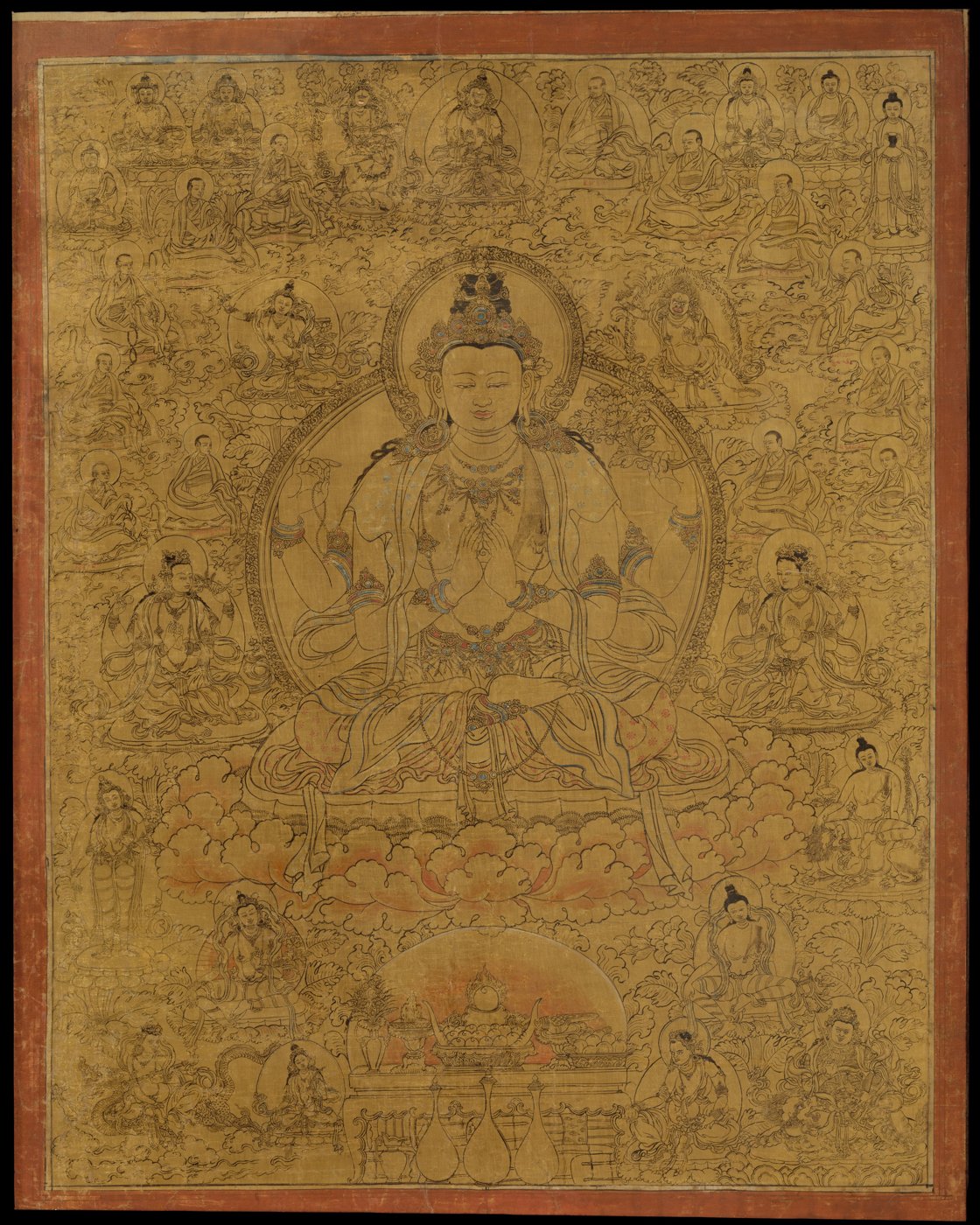
The four-armed form, called Chenrezig Chakzhipa in Tibetan and associated with the Sanskrit name Shadakshari Lokeshvara ("lord of the six syllables"), is the most common image in home shrines and daily practice. It is calm, symmetrical, and quietly radiant.
Posture and Body
He sits in full vajra posture, legs crossed, on a lotus throne topped with a moon disc. His body is white, a color traditionally linked to purity and to the moon-like coolness of compassion. He wears a five-pointed jeweled crown, earrings, necklaces, armlets, and flowing silk scarves, the ornaments of a bodhisattva who remains engaged with the world rather than withdrawn from it.
Look closely at his left shoulder. A small animal skin, usually identified as that of a krishnasara antelope or deer, is draped there. Texts and teachers often connect this animal with gentleness and tender care for others. It is an easy detail to overlook and one of the clearest identifying marks of the form.
The Four Hands
- The two central hands are pressed together at the heart, holding a wish-fulfilling jewel. This gesture is often explained as Chenrezig's prayer that all beings find awakening, and the jewel as the precious mind of compassion itself.
- The upper right hand holds a crystal mala, or rosary. Commonly interpreted as a sign that he draws beings out of cyclic existence one by one, as beads are moved along a string, and as a link to mantra recitation.
- The upper left hand holds a white lotus by its stem, usually blooming near his ear. The lotus grows from mud yet stays unstained, a classic image of a pure mind active within a troubled world.
Painters differ in small ways. The lotus may be shown as a fully open padma or a slightly different flower, the jewel may be blue or multicolored, and the mala may be painted white or translucent. These are stylistic choices within the tradition, not errors.
The Eleven-Headed, Thousand-Armed Chenrezig
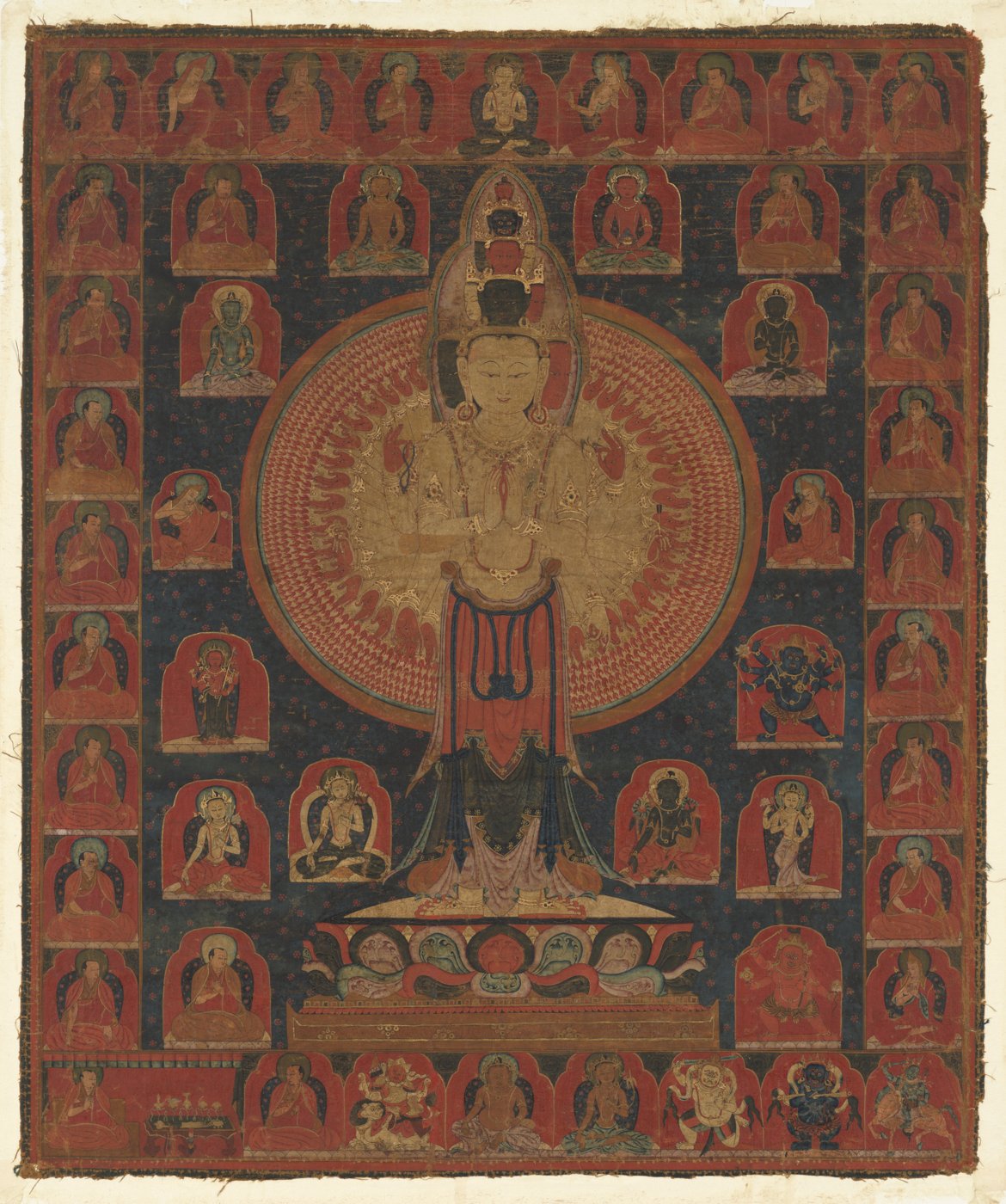
The second major form is much more complex. In Tibetan it is often called Chaktong Chentong, "thousand arms, thousand eyes," and in Sanskrit associated with Ekadashamukha, the eleven-faced Avalokiteshvara. He usually stands upright on a lotus and moon disc, a forest of arms fanning out around him like a halo.
The Story Behind the Form
Tibetan teachers commonly tell a story to explain this image, and versions vary. In its broad outline, Chenrezig vowed that he would free every being from suffering, adding that if he ever gave up on this aim, his body should shatter into pieces. After long labor he looked out over the world and saw that countless beings were still suffering. For a moment he despaired, and in keeping with his vow his head split apart and his body broke into many fragments.
The Buddha Amitabha then came to his aid, gathering the pieces and restoring him with eleven heads, so he could see in every direction, and a thousand arms, so he could reach every being. Some tellings say his head split into ten or eleven pieces; others emphasize Amitabha's blessing differently. What remains constant is the message: compassion that falters can be renewed and made larger.
Reading the Eleven Heads
The heads are stacked in tiers, typically like this:
- Three tiers of three peaceful faces, often painted in shades of white, green, and red, though the color order changes between lineages and workshops.
- A single wrathful face above them, usually dark blue or black, with bared teeth and bristling hair. It is frequently associated with Vajrapani and represents compassion that acts forcefully to cut through obstacles.
- A red, peaceful Buddha head at the very top, which is Amitabha.
The Eight Principal Arms and the Thousand Hands
Of the many arms, eight are painted more prominently. Two join at the heart holding the jewel, as in the four-armed form. The others commonly hold a crystal mala, a Dharma wheel, a lotus, a bow and arrow, and a water vase, with one right hand lowered in the gesture of generosity (varada mudra). The exact assignment of objects to left and right varies between texts and painting traditions, so treat any list as a common pattern rather than a fixed rule.
The remaining arms form a circular aureole, and in careful paintings each palm contains a small eye. These are the "thousand eyes" of the Tibetan name: compassion that not only reaches out but actually sees. This form is closely tied to the lineage of the Indian nun Gelongma Palmo (Bhikshuni Lakshmi) and to the nyungné fasting practice still widely observed in Tibetan communities.
Om Mani Padme Hum: The Six-Syllable Mantra
Chenrezig's mantra is probably the best-known prayer in the Tibetan world. It is carved onto mani stones along mountain paths, printed by the thousands inside prayer wheels, and murmured by practitioners turning their malas. Its classical source is usually traced to the Karandavyuha Sutra.
Literal translation is less straightforward than it looks. "Mani" means jewel and "padme" is related to the word for lotus, so the mantra is often glossed as invoking the jewel and the lotus, the same two objects that appear in Chenrezig's hands. Teachers commonly explain that the jewel stands for compassionate method and the lotus for wisdom, and that the two must work together.
Many teachings also link each of the six syllables to purifying one of the six realms of existence or to cultivating one of the six perfections. Interpretations differ from teacher to teacher, and most emphasize that the mantra's value lies in sincere recitation with a compassionate motivation rather than in decoding it like a puzzle. In thangkas, the six syllables sometimes appear in Tibetan script on the back of the painting, around the deity, or in a decorative border.
Chenrezig and the Dalai Lama Lineage
Within the Gelug tradition and in Tibetan culture more broadly, the Dalai Lamas are regarded as emanations of Chenrezig. This connection helps explain the deep devotion many Tibetans feel toward the Dalai Lama, and why images of Chenrezig and of the Dalai Lama sometimes appear together on altars.
It is not an exclusive association. In the Karma Kagyu tradition, the Karmapas are also understood as emanations of Avalokiteshvara, and other masters across Tibetan Buddhism have been identified with him as well. Buddhist teachers often stress that Chenrezig's compassion is not confined to any single person; it is something practitioners aim to awaken in themselves.
How to Read a Chenrezig Thangka
When you stand in front of a Chenrezig painting, a few steps help you understand what you are looking at. Start with the central figure: count the arms and heads to identify the form, then check the hand attributes and the antelope skin on the shoulder. Next, look above the deity for Amitabha, lineage teachers, or other buddhas, and below for protectors, offering goddesses, or donor figures.
Proportion matters as much as symbolism. Traditional painters lay out every figure on a measured grid so that faces, limbs, and thrones follow established ratios, and a well-drawn Chenrezig feels balanced and calm because of it. If you want to understand why some paintings look "right" and others feel subtly off, it helps to read about how iconometric grids shape deity proportions before comparing pieces side by side.
Practical Tips If You Are Acquiring a Chenrezig Thangka
- Check the attributes. A four-armed Chenrezig with the jewel, mala, and lotus correctly placed shows the painter followed the iconography. Missing or confused objects can signal hurried or decorative work.
- Look at the faces. In the thousand-armed form, eleven small faces are hard to paint well. Expressions that stay peaceful, crisp, and individually finished are a good sign of skill.
- Examine the palm eyes. Fine paintings render them carefully even on the smallest hands; mass-produced prints often blur or skip them.
- Distinguish painting from print. Hand-painted work shows slight variations in line and texture under magnification, while printed reproductions show uniform dot patterns.
- Ask about materials and origin. Mineral pigments, cotton canvas, and a silk brocade mount are traditional. Honest sellers can describe how and where a piece was made.
- Consider consecration. Some owners have a thangka blessed by a qualified lama; customs vary, so ask a teacher in your tradition if this matters to you.
Frequently Asked Questions
Is the four-armed or thousand-armed form more important?
Neither is ranked above the other in a general sense. The four-armed form is the most common for daily devotion and mantra practice, while the thousand-armed form is especially tied to the nyungné practice and the lineage of Gelongma Palmo. Choice usually depends on one's teacher and practice.
Why is Chenrezig white?
White is traditionally associated with purity, peace, and the clarity of an unobscured mind. Some forms of Avalokiteshvara are painted in other colors, such as the red Jinasagara form, so white is typical but not universal.
Can someone who is not Buddhist own a Chenrezig thangka?
Many people do, and Tibetan teachers generally welcome respectful interest. Common courtesies include hanging the painting at or above eye level, keeping it clean, and not placing it on the floor or in a bathroom.
Is Chenrezig the same as Guanyin?
They share a common origin in Avalokiteshvara, but artistic forms, stories, and devotional practices developed differently in Tibet and East Asia. Guanyin is often shown as female, while Tibetan Chenrezig is generally male.
Do I need permission to recite Om Mani Padme Hum?
This mantra is widely recited openly, and many teachers say it can be chanted by anyone with good intentions. Some practitioners also seek a formal transmission from a lama to deepen the practice.
Conclusion
Whether he appears with four calm arms or a thousand reaching hands, Chenrezig carries the same message: compassion that sees clearly and acts tirelessly. Learning to read his jewel, mala, lotus, eleven faces, and open-eyed palms turns a beautiful image into a layered teaching that rewards repeated looking.
If you are studying thangkas or thinking of bringing one into your home, let the iconography guide you. A carefully painted Chenrezig shows its quality in the details, and those same details carry the meaning that has made this bodhisattva so beloved across the Himalayas and beyond.