The Thangka Grid: How Iconometry Gives Every Deity Its Proportions
Look closely at a well-painted thangka and you may notice that two Buddhas, painted centuries apart in different valleys, share almost exactly the same proportions. The width of the face, the length of the forearm, and the distance from the navel to the knees all match. This is not coincidence or copying by eye. It is the result of iconometry, a measurement system that Tibetan painters inherited, refined, and passed from teacher to student for generations.
In Tibetan this practice is often called thig tsa, roughly "line measures" or "drawing grid." It is the hidden skeleton beneath every traditional figure, and once you understand it you will look at thangkas differently. This guide explains how the units work, how the grid goes onto the canvas, why different classes of deities follow different proportions, where the rules come from, how students learn them, and how a little knowledge of the grid can help you judge a painting before you buy it.
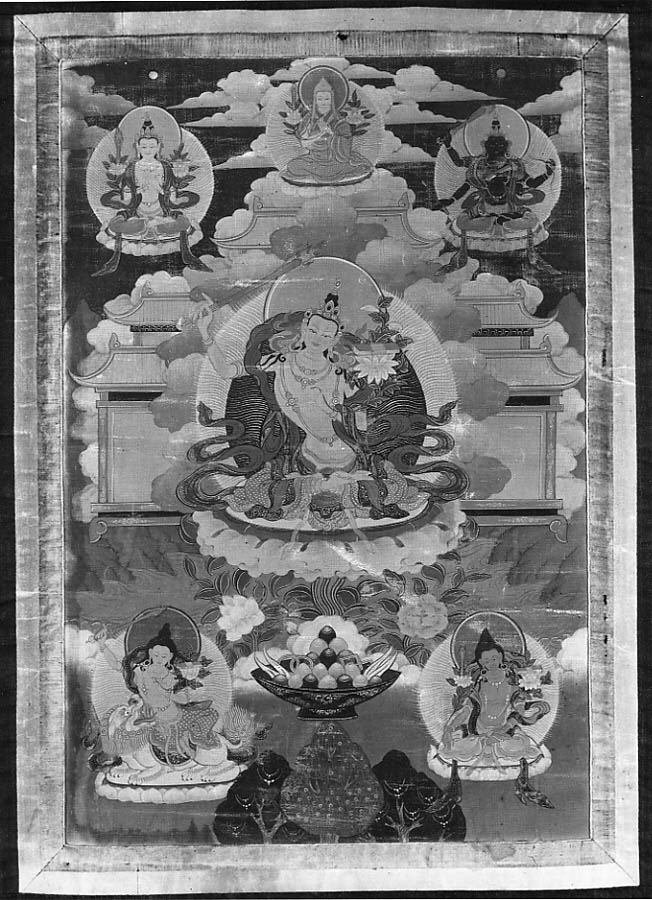
What Iconometry Is, and Why It Matters
Iconometry is the science of proportion applied to sacred images. In the Tibetan understanding, a Buddha's body is not an arbitrary artistic subject. It is a representation of enlightened form, described in scripture as having specific marks and proportions. Painting it correctly is considered a meritorious act, and painting it carelessly is considered a fault. The measurement system exists so that an image can serve as a proper support for devotion, visualization, and ritual.
For this reason, iconometry is not a style choice laid on top of the art. It comes first. Color, shading, landscape, and ornament can vary a great deal between regions and schools, but the underlying proportions are treated as a matter of correctness. A painter can be admired for beautiful clouds, yet a Buddha whose torso is too long will still be seen as wrongly made.
The Units of Measure: Face-Lengths and Finger-Widths
The system is relative, not absolute. Nothing is measured in inches or centimeters. Instead, the painter chooses a basic unit according to the size of the figure and the canvas, and every part of the body is expressed as a multiple or fraction of that unit. A Buddha a hand's width tall and a Buddha filling a wall-sized appliqué follow the same internal ratios.
The Large Unit: the Face
The principal large unit corresponds to the length of the figure's face, from hairline to chin. Terminology varies with lineage and with how Tibetan is romanized. You may meet zhal (face), tho (a span), or tsa chen (a "great" or major measure) for the larger unit. Books and teachers do not always use these words in identical ways, so it is worth checking how any given source defines them.
The Small Unit: the Finger-Width
The large unit is divided into smaller units called sor mo, usually translated as "finger-widths." In the most widely taught systems, one face-length equals twelve finger-widths. Some traditions subdivide the finger-width further, often into quarters, for fine details such as the eyes, lips, and fingers.
With these two units a painter can describe the whole body precisely. A commonly cited example is the standing or seated Buddha, whose total height is often given as about 125 finger-widths, a little over ten face-lengths once the crown protuberance (ushnisha) and other details are included. Exact figures differ between texts and schools, so treat any single number as representative rather than universal.
Laying Down the Grid on the Canvas
Before any drawing begins, the cotton canvas is stretched on a frame and primed, traditionally with a gesso-like mixture of chalk or kaolin and animal-hide glue. It is then polished smooth so that it can take fine lines. Only then does the grid appear.
The Major Lines
Painters typically begin by establishing the overall layout with a few principal lines. These include the central vertical axis, often called the Brahma line (tshangs thig), along with the horizontal and diagonal lines that fix the borders and the main proportions of the composition. Many teachers speak of a set of "major lines" laid down first. These lines are often snapped onto the canvas with a cord dusted in charcoal or chalk, which leaves a straight, faint mark.
The Figure Grid
Once the main axes are in place, the painter marks out the units for the central figure: the height of the face, the line of the shoulders, the navel, the crossed legs of a seated figure, and so on. Using charcoal sticks, often made from fine twigs such as willow or tamarisk, the artist sketches lightly so that errors can be brushed away. When the drawing is right, it is fixed in ink, and the charcoal guidelines are removed or covered by later layers of paint.
The result is that the grid usually disappears from the finished work. What remains is its effect: balance, symmetry, and a sense of calm stability that viewers often feel before they can explain it.
Why Different Deities Have Different Proportions
One of the most interesting aspects of iconometry is that it does not use a single body type. Different classes of beings are drawn with different proportions, and these differences carry meaning. The figures below are approximate and drawn from commonly taught systems. Individual lineages and texts disagree on details.
- Buddhas: The tallest and most harmonious proportions, often around ten face-lengths plus additions such as the ushnisha. Their bodies express complete enlightenment and perfect balance.
- Peaceful bodhisattvas and similar deities: Close to the Buddha's proportions, sometimes slightly shorter, and adorned with jewelry and silks rather than monastic robes.
- Female deities such as Tara: Typically somewhat smaller in overall measure than Buddhas, with graceful, slender limbs, a narrow waist, and full breasts, expressing compassion and beauty.
- Wrathful protectors: Much stockier, often given as around eight face-lengths, with short, powerful limbs, a large belly, and broad shoulders. Their compact mass conveys force and immovability.
- Dwarfish or squat forms: Some wrathful or semi-wrathful figures are shorter still, sometimes around six face-lengths, giving them a heavy, grounded presence.
In the tradition's own terms, these proportions are not about realism. They are visual teachings. The serene height of a Buddha suggests transcendence. The compressed, muscular build of a protector suggests the fierce energy needed to cut through obstacles. Even the shape of the eyes changes, from the long, downcast lotus-petal eyes of peaceful figures to the round, bulging eyes of wrathful ones.
The Textual Sources Behind the System
Tibetan iconometry draws on Indian Buddhist sources. Three tantric scriptures are commonly named as foundations: the Kalachakra Tantra, the Samvarodaya Tantra, and the Krishnayamari Tantra. Indian treatises on the proportions of images, including a well-known work attributed to Atreya, also contributed. These sources do not agree on every measurement, and Tibetan scholars noticed the differences early.
Over the centuries, Tibetan authors wrote their own commentaries and manuals to reconcile or choose among these systems. Menla Döndrub, the fifteenth-century founder of the Menri painting style, is remembered as an important writer on proportion. Later scholars continued the discussion. As a result, a Menri painter, a Karma Gardri painter, and a painter of another lineage may follow slightly different measurements while all considering themselves faithful to scripture. When a teacher says a figure is "correct," it usually means correct according to that lineage's chosen authority.
How Students Learn the Grid
Traditional training begins with drawing, not painting. Students typically spend a long period, often described as several years, mastering iconometric drawing before they handle much color. They start with the head and face of the Buddha, drawing the grid and the features over and over until the ratios become second nature. Then they move to full figures, bodhisattvas, female deities, and finally the complex wrathful forms with multiple heads and arms.
Practice is often done on wooden boards coated with a dusty surface that can be wiped clean, which allows endless repetition at little cost. Teachers correct the drawings line by line. Over time, students memorize the measurements so thoroughly that experienced masters can sketch a well-proportioned figure with only a few guide marks, or sometimes none at all. The grid moves from the canvas into the hand.
Only after this foundation is secure do students progress to mixing mineral pigments, shading, and the most demanding finishing work, including applying and burnishing gold line work. Proportion comes first because a beautifully gilded figure built on a faulty drawing is still faulty.
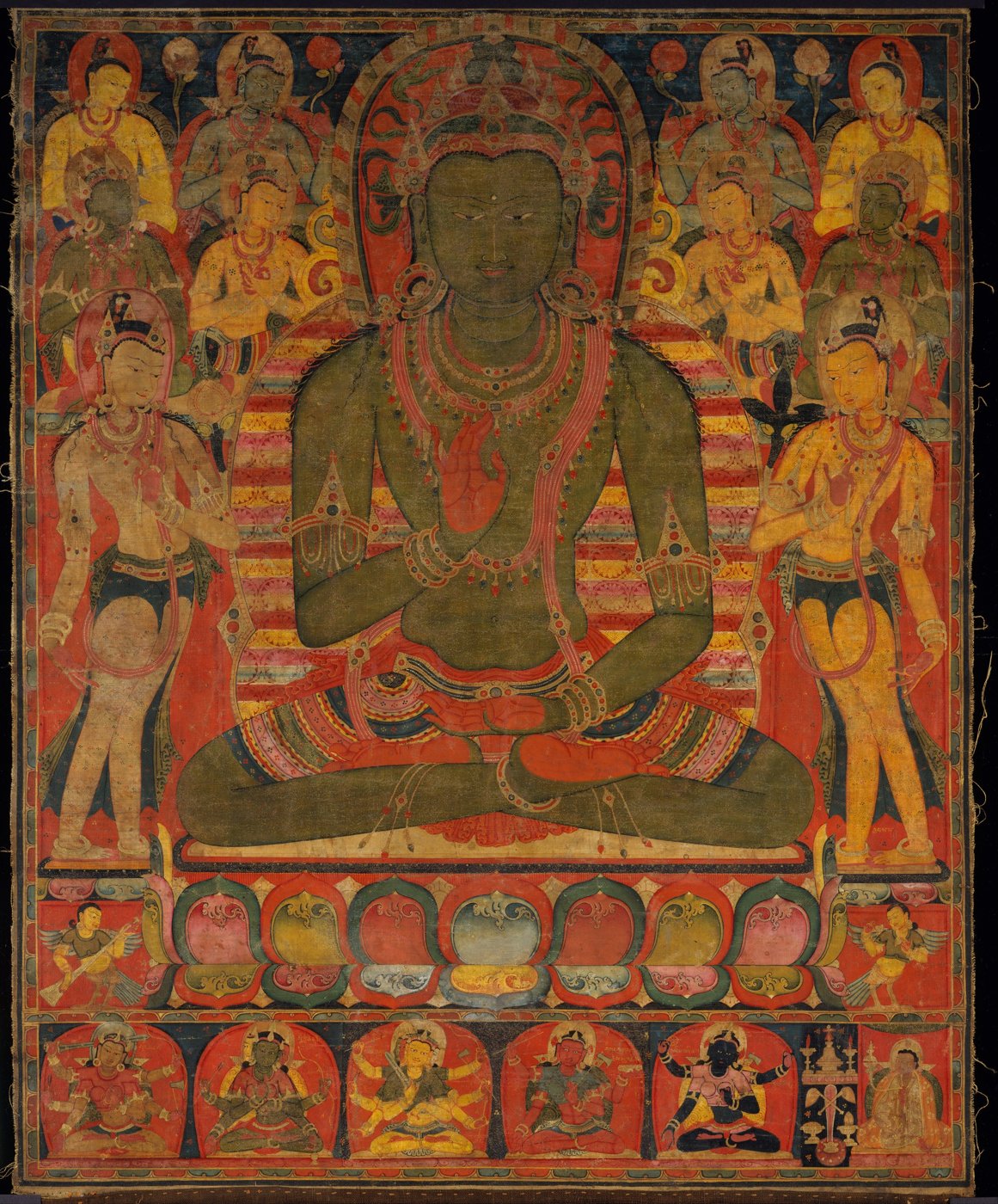
Using the Grid to Judge a Thangka's Quality
You do not need to be a painter to make use of iconometry. A few careful observations can tell you a great deal about the training behind a work.
- Check the symmetry. Imagine the central vertical line running through the deity's nose and navel. In a peaceful, frontal figure, the two halves should mirror each other closely, from the eyes and ears to the knees.
- Compare the face to the body. Use the face as a rough ruler. Does a seated Buddha's torso look about the right number of faces tall? Does a protector look compact rather than stretched?
- Look at the hands and feet. These are hard to draw well. Fingers should be evenly tapered and graceful; feet in lotus posture should sit naturally on the thighs.
- Study the eyes and expression. Correctly drawn eyes give a peaceful deity a calm, inward gaze. Uneven eyes are a common sign of weak training.
- Examine the secondary figures. Small deities around the main figure should also be well proportioned. Less experienced painters sometimes take care with the center and rush the edges.
- Use raking light. Holding a light at a low angle can sometimes reveal traces of underdrawing or ink lines, though in a good painting these are usually hidden. A printed image will lack the texture of real pigment layers entirely.
Keep in mind that slight variations may reflect a different lineage's measurements rather than an error. If something looks unusual, it is reasonable to ask the seller which painting tradition the artist trained in.
Frequently Asked Questions
Is the grid still visible on a finished thangka?
Usually not. The charcoal lines are wiped away or covered by paint, and the inked drawing is concealed beneath layers of color and shading. Occasionally faint traces show at the edges or under strong side lighting, but the grid normally survives only in the proportions it produced.
Do all thangka painters use the same measurements?
No. The general system is shared, but specific measurements differ by lineage and by the textual authority each school follows. Menri, Karma Gardri, and other traditions can vary in details such as overall height and limb length.
Is a painting with "wrong" proportions worthless?
Not necessarily as decoration, but within the tradition it would be considered less suitable as a support for practice. For a devotional piece, correct proportions matter a great deal. For a folk or regional painting, some looseness may be part of its character.
Can a stocky protector deity look correct even though it seems oddly proportioned?
Yes. Wrathful figures are deliberately drawn with shorter, heavier proportions. Their squat build is intentional and symbolic, not a mistake.
How long does it take to learn iconometry?
Traditional accounts describe several years of focused drawing practice before students move fully into painting, though the exact length depends on the teacher, the student, and the lineage.
Conclusion
Iconometry is the quiet discipline beneath Tibetan sacred art. A face divided into finger-widths, a few snapped charcoal lines, and years of patient practice allow painters to give each class of deity its proper form, from the serene height of a Buddha to the grounded strength of a protector. The system links today's artists to Indian scriptures and Tibetan commentators, while still leaving room for the distinct voices of different lineages.
For anyone who loves or collects thangkas, learning to see the invisible grid is one of the most rewarding skills you can develop. It sharpens your eye, helps you recognize real training, and deepens your respect for a tradition in which careful measurement is itself a form of devotion.