Gold in Thangka Painting: 24-Carat Gold, Burnishing and Fine Line Work
Stand in front of a well-made thangka in a dim room and the gold seems to arrive before anything else. The fine lines around a deity's robes, the flames of an aureole, and the crowns and jewelry all hold a soft glow that shifts as you move. In many Himalayan painting traditions, gold is not decoration added at the end. It is a material with its own preparation, its own tools and its own place in the order of work, and it calls for some of the most demanding skills a painter learns.
This guide explains how gold is used in thangka painting: how pure gold is turned into paint, how it is drawn into hair-fine lines, how entire backgrounds can be laid in gold, and why painters polish selected areas with a smooth stone. It also covers how to tell real gold from metallic substitutes, why gold-rich works are priced higher, and how to care for gilded areas so they stay bright for generations.
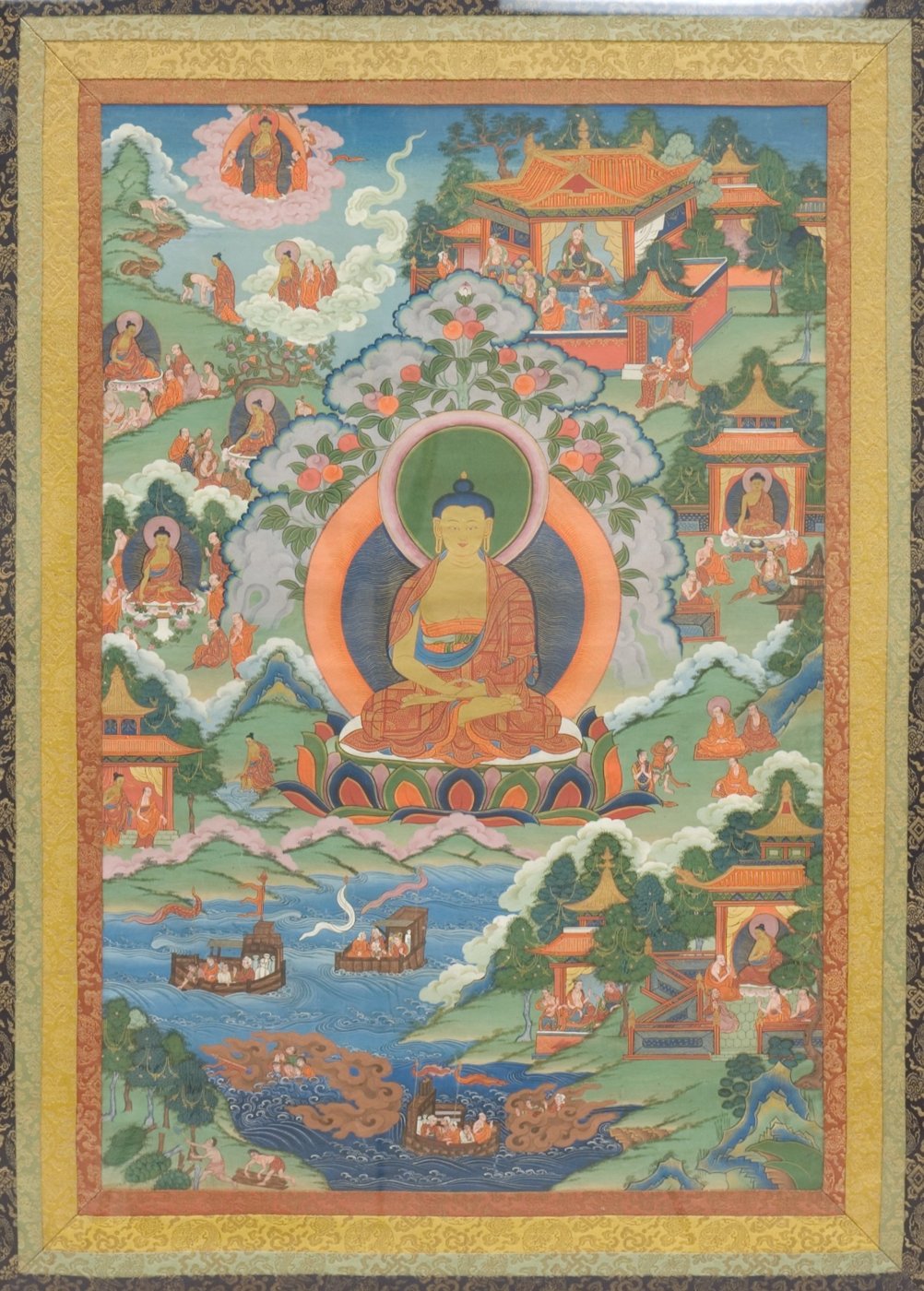
What "Real Gold" Means in a Thangka
When painters and studios describe a thangka as using 24-carat gold, they mean pure gold rather than an alloy. Pure gold is valued here for practical as well as symbolic reasons. It is soft enough to grind finely and burnish well, its color is warm and even, and it does not tarnish the way brass or copper-based powders can.
From Leaf to Paint
Traditionally, painters start with thin gold leaf or flakes. These are ground for a long time, often in a mortar or on a stone, sometimes with a little glue or water to stop the particles from clumping. The aim is a very fine powder; coarse gold gives a gritty line and a dull finish. Some painters rinse the powder repeatedly to separate the finest particles. Once ready, the gold is mixed with a binder, traditionally an animal-hide glue, to make a paint that flows from a brush.
Practices vary between regions, lineages and individual workshops. Some painters prepare their gold entirely by hand; others now begin from commercially produced gold powder. Both can produce excellent results, and neither is automatically more "authentic" if the material really is gold.
Where Gold Appears
- Outlines and patterning on robes, brocades and textiles
- Crowns, jewelry, ornaments and ritual implements
- Halos, aureoles and rays of light
- The skin of certain figures, depending on iconographic tradition
- Architecture, thrones and lotus details
- In some works, the entire background
If gold matters to you, ask the source directly what kind it is, and whether it is used throughout or only in some areas. A trustworthy studio will answer plainly. Buy authentic thangka painting from a studio that is willing to explain its materials, show close-up photographs, and describe where gold appears rather than simply calling a piece "gold thangka." Buy authentic thangka painting from a source that will tell you plainly which areas are done in genuine gold and which are not.
Ser Thig: The Art of Gold Line Drawing
Gold line work, often called ser thig, is among the final stages of painting and one of the hardest to do well. After the colors have been laid in, shaded and outlined, the painter returns with fine brushes and gold paint to draw the lines that give the image its finish.
These lines can be astonishingly delicate. On a fine piece, you may see repeated floral motifs on a robe hem, lines tracing the folds of drapery, or tiny patterns inside a jewel no larger than a fingernail. The paint must be mixed to exactly the right consistency: too thick and it drags or forms blobs; too thin and it will not cover evenly or burnish properly. The painter's hand must stay steady over long, unbroken strokes, since corrections in gold are difficult to hide.
What to Look For
- Consistency: lines should keep an even width where intended and taper cleanly where they should.
- Clean edges: under magnification, good gold lines sit crisply on the color beneath, without smudging.
- Density with control: plenty of gold is not the same as good gold. Restraint and placement count as much as quantity.
Serthang: Full-Gold Backgrounds
A serthang, or "gold thangka," is a painting in which the background is covered largely or entirely in gold. The figures are usually drawn in fine lines, frequently red, with limited color, so the composition reads almost like a drawing on a field of light. Related styles use other ground colors, such as red-ground and black-ground thangkas, each with its own visual character and, in some contexts, its own ritual associations.
Serthang works use far more gold than ordinary thangkas and require an even, flawless ground, which is difficult to achieve with a brush. Any patchiness or streaking shows immediately. Because the line work must sit cleanly on top of the gold, the painter has very little margin for error. These factors make serthangs among the most material-intensive and technically demanding forms in the tradition.
Iconographic conventions about which subjects suit a gold ground vary by lineage and region. It is best not to assume that one rule applies everywhere; teachers and painting traditions differ.
Burnishing: Polishing Gold with an Agate Stylus
Once the gold has dried, the painter can burnish selected areas. Traditionally this is done with a smooth, hard tool, often a polished agate or similar stone set in a handle, though other smooth burnishers have been used. Rubbing the stone gently over the gold compresses the particles and turns a soft, matte surface into a reflective shine.
Matte Against Polished
The real artistry lies in choosing what to burnish. A painter might polish the outer edge of a halo and leave the center matte, or burnish a crown while leaving surrounding ornaments soft. On full-gold grounds, the burnisher can be used to create patterns visible only when light strikes at an angle. This interplay of matte and polished gold gives depth to a surface that would otherwise be flat.
Burnishing must be done with care. Press too hard or too early and the gold can lift or the underlying layer can be damaged. The binder, the thickness of the gold and the preparation of the canvas all affect how well an area takes a polish.
How Gold Catches Lamp Light
Thangkas were traditionally seen in shrine rooms, assembly halls and homes lit by butter lamps or small flames. In that kind of light, gold behaves differently from pigment. The colors recede into shadow, while burnished gold picks up each flicker and seems to move. Figures can appear to emerge from darkness, their ornaments and outlines glowing softly.
This quality ties gold closely to the meaning of many images. Buddhas and pure realms are often described in terms of radiance, and gold gives painters a way to suggest that light materially. A painting of a pure land, for example, may use gold generously for palaces, jeweled trees and rays of light; if you are interested in how that imagery works, our guide to the meaning of an Amitabha Buddha thangka explores Sukhavati's symbolism in more detail. Gold is not the meaning itself, but it helps carry it.
For display at home, try viewing a thangka under warm, low, angled light. Bright overhead lighting tends to flatten the effect, while a lamp placed to one side brings the burnished areas to life.
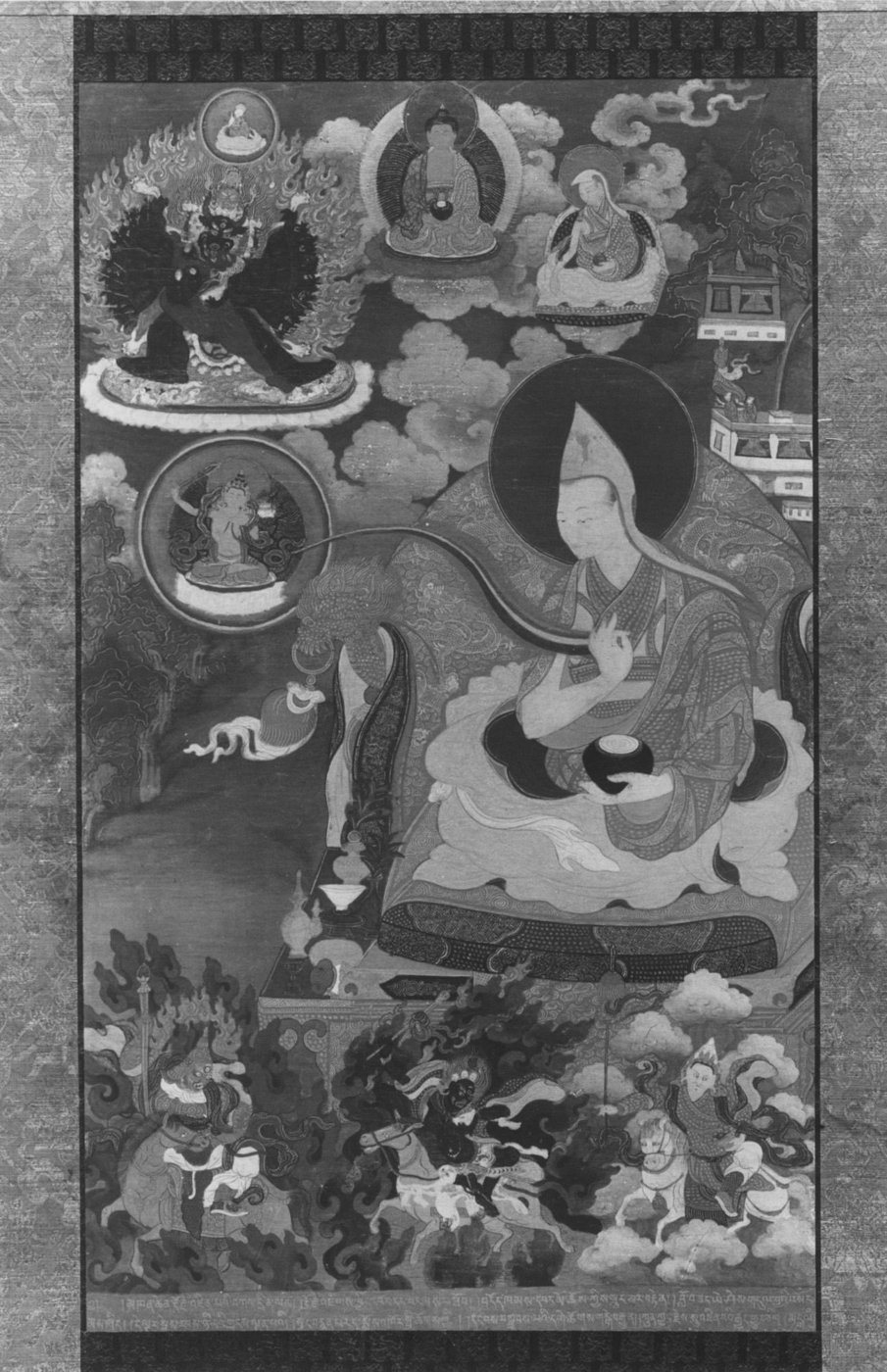
Telling Real Gold from Metallic Paint
Many affordable thangkas use metallic paints made from brass or bronze powders, or mica-based pigments. These can look attractive at first, but they differ from real gold in several ways. No single test is conclusive, so it helps to look at several signs together.
- Color: real gold is warm and slightly soft-toned. Imitation powders can look brassy, greenish, or unnaturally yellow.
- Sparkle: mica-based paints often glitter with tiny points of light. Real gold tends toward a smooth sheen, not a sparkle.
- Burnished contrast: true burnishing gives a distinct polished-versus-matte effect. Metallic paints rarely burnish in the same way.
- Aging: brass and copper-based paints can darken or develop a greenish cast over time. Pure gold does not tarnish, though it can become dirty or worn.
- Line quality: fine gold lines that stay crisp and even under magnification point to careful work, whatever the material, but very fine burnished line work is most often found with real gold.
Never scratch, rub, or apply chemicals to a painting to "test" the gold. You may damage it permanently. Instead, ask for clear close-ups taken under raking light, and ask the seller to state in writing what material was used.
Why Gold-Heavy Thangkas Cost More
Several factors push up the price of a thangka rich in gold. The material itself is expensive, and its price moves with the market. Preparation takes time, whether the painter grinds leaf or refines purchased powder. Gold line work and burnishing are slow and demand advanced skill, usually from senior painters. A full-gold background requires a large quantity of gold and a near-perfect application.
Price, however, should reflect quality, not only quantity. A painting covered in gold but weak in proportion, drawing and color is not a better thangka than a restrained one with superb draftsmanship. Buy authentic thangka painting with an eye to the whole work: the accuracy of the iconography, the fineness of the shading, the care in the line work, and only then the amount of gold. Buy authentic thangka painting with your eyes on the whole image: let the gold support strong drawing, balanced proportions and calm, well-finished faces rather than replace them.
Frequently Asked Questions
Is all gold in thangkas 24-carat?
No. Many works use pure gold, but others use lower-grade gold, gold-colored metallic powders, or a mix of materials. Descriptions vary in accuracy, so it is reasonable to ask a seller directly which material was used and where.
What does "serthang" mean?
It refers to a thangka with a gold background, usually with figures drawn in fine lines rather than fully colored. Conventions about subject matter and line color differ between traditions.
Can gold on a thangka tarnish?
Pure gold does not tarnish, though dust, smoke and handling can dull it. Metallic paints based on brass or copper may darken over time, which is one way older substitutes become noticeable.
How should I clean gold areas?
In general, you should not clean them yourself. Avoid water, cloths and cleaning products, since gold is bound with glue and can lift. Light dust can be left alone or addressed by a qualified conservator.
Why do some gold areas shine and others look matte?
The shiny areas have been burnished with a smooth stone tool, while the matte areas were left unpolished. Painters contrast the two on purpose to create depth and pattern.
Conclusion
Gold in a thangka is the result of patient, skilled work: refining the material, mixing it with binder, drawing it into lines that may be finer than a hair, and polishing chosen areas with a stone until they catch the light. Understanding these steps helps you see past surface glitter and recognize real craft.
To care for gilded areas, keep the painting away from damp, smoke and handling, hang it where light is gentle, and use a silk cover when it is not being viewed. Treated with respect, the gold will keep its quiet glow, much as it has in shrine rooms for centuries.